Archives: Article

Lake District Writers

The spectacular landscape of the Lake District has influenced some of England’s best-known writers. In particular, poets of the late eighteenth and nineteenth century, such as William Wordsworth, Thomas de Quincey, John Ruskin and Samuel Coleridge.

Also, many children’s authors have drawn inspiration from our surrounding scenery, such as Beatrix Potter, Arthur Ransome and even the creator of Postman Pat.

Another immensely influential figure is Alfred Wainwright, creator of many walking guides to the area.

For over a century, writers and poets have fallen in love the dramatic beauty and solitude of this stunning corner of the country and its 885 acres of mountains, meadows and fells have moved them in very different ways, leaving a legacy that ranges from the Romantic to the Gothic.

Beatrix Potter

Beatrix Potter lived from 1866 – 1943 and is best known for her beautifully illustrated books featuring Peter Rabbit, Jemima Puddle-Duck and friends. She spent many childhood holidays in the Lake District and these influenced her work.

With the profits from her publications, she bought Hill Top farm and other nearby estates, while Brockhole (which you can visit) was the home of her cousin, Edith, who married merchant William Gaddum. You can also meet some of her whimsical wild characters at The World of Beatrix Potter in Windermere.


Alfred Wainwright

Born in Blackburn, Lancashire in 1907, Alfred Wainwright first visited the Lake District when he was 23. He later moved to Kendal and devoted his life to mapping the area, writing seven guidebooks.

His Pictorial Guides to the Lakeland Fells are a unique mixture of beautiful pen-and-ink sketches, maps and musings and feature 214 fell tops, which are known as ‘Wainwrights’ and many walkers like to try and bag them all. Wainwright died in 1991 and there is a memorial to him in the church at Buttermere. His ashes were also scattered above the village on his favourite mountain, Haystacks.


William Wordsworth

William Wordsworth is one of the most famous writers inspired by the Lake District, who lived from 1770 – 1850. His ‘Daffodils‘ poem beginning “I wander’d lonely as a cloud” is a quintessentially Cumbrian inspired.

He was born in Cockermouth, just north of the National Park and went to school in Hawkshead. After attending Cambridge University and then living in Dorset, Wordsworth moved back to the Lakes to Dove Cottage in Grasmere in 1799 and then Rydal Mount in 1813.

Wordsworth’s ‘Guide through the District of the Lakes’ published in 1820 sparked off the first beginnings of mass tourism to the area.


John Ruskin

John Ruskin was a renowned Victorian poet, artist and philosopher of society and conservation, who lived from 1819 – 1900. Born in London, Ruskin was profoundly influenced by his childhood experience of the Lake District and his writings on architecture and art influenced Pre-Raphaelites artists such as Edward Burne-Jones and William Morris. In 1871, he bought Brantwood near Coniston and retired there in 1884. He is buried in Coniston’s churchyard.


Arthur Ransome

Born in Leeds in 1884, Arthur Ransome learned to sail on Coniston and went to school in Windermere. He wrote a series of 12 Swallows and Amazons books, mostly set in the Lake District, with his stories following the adventures of the Walker and Blackett children camping on islands, mining for gold, fighting fell fires and conquering mountains. Wild Cat Island is thought to be Peel Island in Coniston Water and Kanchenjunga is thought to be The Old Man of Coniston.


John Cunliffe

Born in 1933, John Cunliffe wrote the world-famous Postman Pat stories. Who’s many adventures were turned into a TV series and shown in more than 50 countries. Cunliffe lived in Kendal for six years and much of his inspiration came from the local Cumbrian countryside. Greendale was inspired by Longsleddale and the Greendale post office was inspired by Beast Banks post office, in Kendal. Now closed, the building is marked with a plaque.


If you’re planning to explore the Lake District, why not browse our collection of Cumbrian cottages.

Bring the Lake District Home this Half Term

With half term upon us and a welcomed break from home schooling, we have put together a few things you can do to bring the Lake District to your doorstep.

Dark Skies Festival Lake District February Half Term

Experience a Stargazing Extravaganza

Light up your February with a spectacular array of online events celebrating the wonders of the Cumbrian night sky. If you are a first-time stargazer, wishing to expand your knowledge further or even searching for fun family activities during half term, the Dark Skies Festival can be enjoyed by everyone. Take a look at all the events and dates .

Bring The Outside In

Watch live footage from around the National Park via a number of webcams that have been placed across the Lake District, so you don’t miss a sunset or sunrise during lockdown. Find out more over on the official Lake District National Park website and to enjoy even more of our stunning surrounding landscapes from home this half term, head over to follow @lakedistrictnpa on Instagram.

Delve Into Helvellyn

To help us feel even more connected with the outdoors, Terry Abraham delights with ‘Life of a Mountain: a year on Helvellyn’. He joins Fell Top Assessor, Zac on one of his daily ascents up the infamous, peak to report on ground condition and help keep local walkers safe during the winter weather. Watch the short film on iPlayer.

If you’re planning an escapes to the Lake District post-lockdown, check out our Cumbrian cottages.

Christmas 2020 North Yorkshire Moors & Coast

As we look back on an eventful twelve months, all of us here at Cottage Escapes would like to wish you a wonderful Christmas and New Year.

Some of you may be lucky enough to get your North Yorkshire Moors and Coast fix over the festive season, so here’s a quick rundown of some of the things you can see and do whilst you’re with us.

Things will undoubtedly be a little different, but rest assured that all of our properties, grounds and shared facilities are Covid-safe and sanitised and we are enforcing social distancing and check-in regulations in line with Government advice. Please also follow the guidelines about travel according to which Tier you live in before you join us for a stay.

Christmas North Yorkshire Moors Railway

Christmas Moorlander

2020 has been a challenging year for Lapland and time is running out. Santa and his team need your help – his sleigh is out of action; reindeers are furloughed and the elves need to build all of the presents in time for Christmas Eve. Celebrate the most wonderful time of the year with North Yorkshire Moors Railway starting at a festive Pickering Station. Hop on board the heritage carriages and into your own private compartment where your festive adventure starts. You’ll hopefully catch a glimpse of the big man himself too, as he prepares for the most magical night of the year. Find out more and book:

Drive Through Cinema

Head to Oliver’s Mount on 12 or 13 December as Yorkshire Drive In Cinema roll on through to spread some festive cheer with a smorgasbord of seasonal favourites, from Home Alone and Elf to The Polar Express. Find out more and book:

Seasonal Screenings

Pop-up Cinema Yorkshire will be setting up a giant projector in Stepney Hill Farm’s beautiful rustic barn on 18 and 19 December for a special Christmas party screening of Love Actually, It’s a Wonderful Life, The Grinch and Frozen 2. Find out more and book:

Christmas Express

Santa’s elves are here in Scarborough until 19 December to help your little ones write and send their Christmas lists straight to the North Pole from the North Yorkshire Coast. Book a truly festive family experience:

Filey Fishtive Tree

Although there’ll be no festive light switch on this year, if you find yourself exploring the fabulous fishing village of Filey, see if you can spot the giant crab pot Christmas tree adorning the North Yorkshire Coastline, which will be as tall and brightly lit as ever.

Enchanted Experience

Add a touch of extra sparkle to your festive getaway and enjoy an exclusive meeting with Father Christmas, Mrs Claus and their magical companion WonderPhil at Castle Howard until 23 December. Tickets include access to the estate where you will enjoy a one hour show featuring your favourite festive duo. The big man himself will then invite each child, one bubble at a time, over to the roaring fire to gather their Christmas wishes and for a festive photo opportunity. Before making their way to the toy workshop to choose a gift from Mrs Claus. A special post box to the North Pole will also be ready to receive little one’s letters, so don’t forget to bring them along. Find out more and book:

A Dickensian Christmas

Step out of the cold and into a magical snow-covered world where Christmas comes alive at York Castle Museum. The famous Victorian street, Kirkgate is set to transform into a glistening stage where large-scale projections dance across the walls, bringing to life famous characters from the Nutcracker. Oversized decorations, ballerinas and toy soldiers adorn the street and merry music plays – immersing you in a new and truly unique festive experience. Find out more and book:

Christmas walk North Yorkshire Moors

Festive Woodland Wanders

Winter here on the edge of the North Yorkshire Coast stretches from the Christmas period through to February and is a season that can bring beautiful blankets of snow to the Moorlands, leading to crisp days that really highlight our big sky views. There’s also a small selection of independent boutiques and eateries still offering seasonal shopping and tasty takeaway treats and plenty to see and do across the – from bauble hunts to pop up stalls. We recommend warm clothing, shorter walks and finding a cosy spot in front of the roaring fire with a mug of hot chocolate (or perhaps something a little stronger) at the end of a day spent exploring our stunning surrounding scenery. If you’re planning a visit, make sure to keep up to date with the latest advice and guidance

Let’s face it – 2020 has been a bit of a let down – so why not start 2021 with a bang and book a stay for up to 6 guests (same household/support bubble) with us here at Mulberry Cottage and enjoy a little extra space to welcome the New Year. Find out more and book 👉

Winter Lake District Walks

Lake Windermere Lake District
Planning a stay in the Lakes as the colder weather creeps in?

Here are our top 5 winter Lake District walks all within easy distance of Keswick and Windermere and perfect for when you book at stay one of our Cumbrian cottages.
Brockhole on Windermere

There’s 30 acres of grounds to explore designed by the famous landscape architect Thomas Mawson and these environmental friendly surroundings offer lots to see and do. With kitchen gardens, wild roses and a flower meadow only some of the highlights, there’s plenty to offer all year round.

Keswick to Threlkeld Railway Path

This winding trail through forest and woodland offers a stunning view of the seasons changing colours. Access Brundholme Woods, following Brundholme Road up to Latrigg and then through to Threlkeld, with the option of a circular route back to Keswick. The bridges you cross were extensively damaged during the floods of 2015, but recent repair work has now made it the perfect place to follow the fast flowing rivers.

Rosthwaite Circular Walk

Not far from Keswick is a trail that will take you to Millican Dalton’s cave and on a brisk winter afternoon, will give you a small taste of his way of life – having lived in the rockface dwelling from the 1920’s for almost 50 years. But not as a hermit; as he regularly took walkers and climbers on guided tours of the local area. This gentle stroll takes you along the riverside and offers the option of heading to Castle Crag for some spectacular views.

Whinlatter

Visit England’s only mountain forest is in all it’s glory year round. There are a few trails, but the Seat How Summit is a strenuous stroll that will reward you with fabulous vistas of Derwentwater, Bassenthwaite Lake and the Helvellyn and Skiddaw mountain ranges, which include some of the UK’s highest peaks. A short 15-minute drive from Keswick, Winlatter Forest is one of our favourite places to enjoy winter Lake District walks for all abilities.

Millerground and Adelaide Hill

This short stroll is great on one of Cumbria’s clear and crisp afternoons and perfect for all the family. Pack a picnic and spend some time taking in the view over Windermere (once you’ve made it up the small Adelaide Hill) or pick a spot overlooking one of many waterfalls, which are wonderful after a rainstorm.

If you join us for a stay in one of our Cumbrian cottages during the winter months, be sure to keep these walks across the Lake District in mind.

History of Thirley Cotes

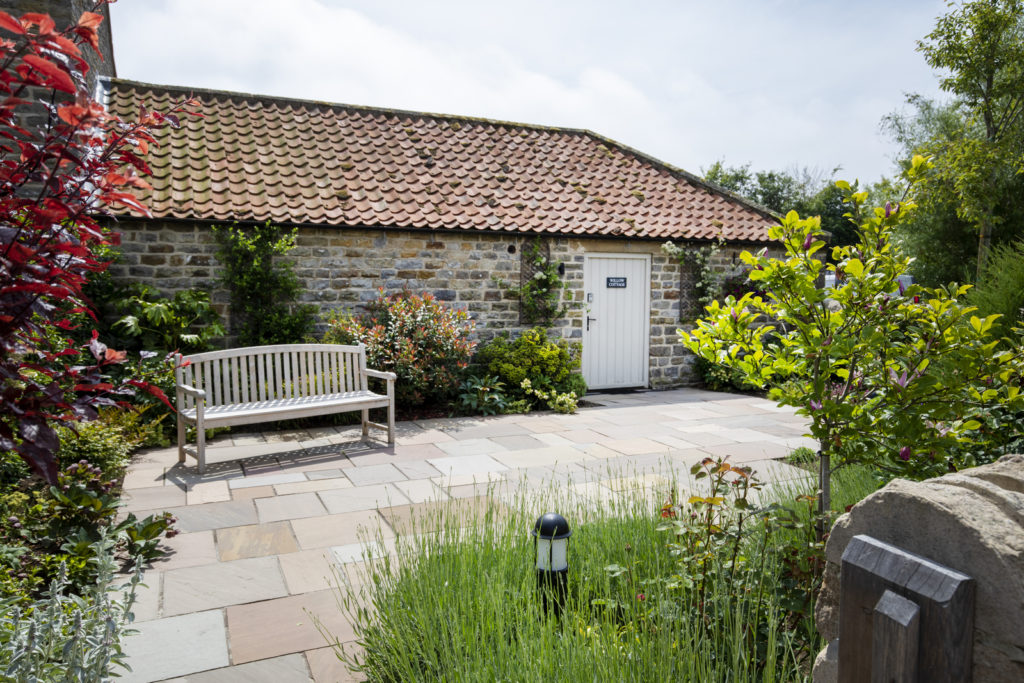
Willow Cottage Pet Friendly Cottage Scarborough 2021 & 2022

We take a modern approach to creating our portfolio of properties, but the history of the Thirley Cotes Farm estate here in North Yorkshire dates back hundreds of years.

Grade II Thirley Cotes Farm is nestled in the tiny village if Harwood Dale on the edge of the North Yorkshire Moors and Coast between the seaside towns of Scarborough and Whitby and is home to a rich tapestry of antiquity.

Early origins

The history of Thirley Cotes Farm dates back centuries, with the first direct reference to settlement on-site in the Domesday Book, compiled in 1085 as an index of taxable properties held under William I. Appearing as Torlie, Thirley is recorded as a small hamlet that comprised just 1.8 households and formed part of the manor of Falsgrave. This was one of a number of manors listed under the lost Hundred of Dic, which included Great Ayton, Cloughton, Scalby and Filey, amongst others. The name ‘Torlie’ is probably Old English in origin, from ‘Tor’, meaning rocky outcrop and ‘leah’, meaning clearing.

After the Norman Conquest

Thirley was gifted by William I to William de Percy as part of the parish of Hackness. Percy had arrived in England in 1067 and held extensive estates across North Yorkshire and Lincolnshire. He was the patron of the new Norman Whitby Abbey, built on the ruins of the Anglo-Saxon Streoneshalh Abbey and founder of the English Percy line, later Earls of Northumberland, one of the most influential families in medieval England

Willow Cottage Pet Friendly Cottage Scarborough

First Edition Ordinance Survey map

Surveyed in 1848 – 49 and published 1854, the First Edition OS map suggests that the Thirley Cotes originally comprised a small hamlet of two or perhaps three farmsteads clustered on each side of the bend in Waite Lane. By the mid-19th century, only the properties on the east side of the lane remained, including Grade II listed 18th-century Thirley Cotes Farmhouse. The layout is typical of the high farming period. It comprises three ranges set out around a central foldyard, with the main barn on the north side and the farmhouse situated in the south-east corner; set a little apart from the rest of the complex, with the main façade facing south. This location allowed for easy access to the farm, while at the same time setting the building slightly apart to minimise the smell and noise coming from the yard.

Late 18th and 19th century

Thirley Cotes formed part of the Hackness Estate, owned in the early 19th century by the Johnstone family, descendants of the Vanden-Bempdes who had held the manor since 1696 and changes in tenancy and land ownership brought about by enclosure encouraged greater investment in farm properties across the country. Such investment was necessary to meet the increasing demands being placed on agricultural production by the rate of population expansion in the latter half of the 18th century. Many of these people occupied the growing industrial towns of the North, particularly the foundries and ironworks of Cleveland and mills and mining settlements of Yorkshire. The result was a change in agricultural production that was to have a marked impact on British farming for the next 100 years.

Holly Cottage North Yorkshire Moors

1851

The farm appears in the 1851 census, where it is recorded as Thurlow Coates and was tenanted by George White, a farmer of 160 acres who employed six labourers. Also living at the property were his wife, Mary, their two sons and a daughter. A general servant, Mary Linton also resided at the farm, as well as two named labourers, Edgar Grooves and William Robinson.

Second Edition Ordnance Survey map

The Second Edition 25-inch OS map published in 1893 is the first to show the property in detail and indicating a degree of expansion in the latter part of the century, with the addition of the south range and development of the small paddock to the east. This included a cart shed and various other ancillary buildings, as well as an open linear block built against the range, probably also for equipment storage. A small extension was also added to the rear of the west range and an L-shaped building was added to the western end of the main barn. The latter was probably a byre, with a small open yard to the east. At some point after 1912, a large shed was built to cover the foldyard, the posts of which remain visible today, although cut off at the base.

Today, Thirley Cotes Farm is home to a collection of 8 beautifully restored self-catering holiday cottages surrounded by 21 acres of grounds complete with wildlife and woodland and sleeping 2 – 42 guests. From boltholes for two to big and beautiful retreats for all the family, we’ve got an escape to suit you. All our properties are pet friendly, too, perfect for exploring the surrounding scenery.

Experience the history of Thirley Cotes Farm first-hand when you join us for a stay.

Best Beaches here on the North Yorkshire Coast

Searching for sea, sand and (fingers crossed) sun? Then look no further than the North Yorkshire Coast.

Synonymous with quintessentially British shorelines, the North Yorkshire and Cleveland Heritage Coast is 36 miles long and stretches from Saltburn (just north of the National Park) down to Scalby Mills. Incorporating some of the best beaches in the UK and showcasing thrill-factor waves, secluded coves, dramatic cliffs, quaint fishing villages and hypnotic views.

When the sun shines, it can feel more like The Seychelles than Scarborough and with four of Yorkshire’s beaches achieving the Blue Flag Award (North Bay, Whitby West Cliff, Bridlington North and Hornsea) you can be sure of the highest standards for your trip to the seaside.

It’s the mix of jolly towns with their bucket-and-spade beaches, ice cream parlours and amusement arcades and picture-perfect villages with cobbled-street charm that make the surrounding scenery a winner for all ages and with clifftop walks, surf-able torrents and rock-pooling aplenty, there’s a something to suit every taste.

Here’s 7 of the best beaches on our doorstep and dotted along the North Yorkshire Coast.

Saltburn-by-the-sea

If you block out the cars, you could imagine yourself in a Victorian seaside town, with pin-neat public gardens overlooked by a terrace of traditional buildings, while below, a poker-straight pier with a small amusement arcade strikes out to sea. Linking the upper and lower promenades is Britain’s oldest surviving water-balanced funicular (built in 1884) and stretching five miles to Redcar is a broad scattering of sand, nestled below jolly-coloured beach-huts and a playground for sunbathers. Facing the full force of the North Sea, Saltburn is one of the UK’s top surf spots, but the beach is also protected from winds by the bulk of Huntcliffe at the eastern end.


Runswick Bay

If you’re looking for a long stretch of sand in a pretty setting but without any seaside razzamatazz, Runswick Bay is for you. This tiny former fishing village (a stack of pantile-roofed cottages that cling to the cliffs) gazes over a shingle beach that stretches a mile and a half east to the Kettleness headland. Here you make your own entertainment, whether that’s building sandcastles, paddle-boarding, investigating rock pools or a walk along the cliffs. Sandside Café (Cleveland Way) sits directly above the and boasts a small terrace where you can enjoy a simple selection of sandwiches, salads and cakes, as well as pick up buckets, spades and fishing-nets – and that’s about it. Bliss.

Robin Hood’s Bay

This popular and picturesque village totters steeply down the cliff-side to its eponymous bay and is a magnet for fossil-hunters and rock-poolers. The stretch of shore is part of Yorkshire’s Jurassic Coast and is home to cliffs yielding belemnites and ammonites aplenty; gradually working their way onto the beach. At low tide, the exposed rocks are perfect for examining with nets and buckets (all creatures to be returned to the water, of course) and are ideal for getting wet and messy, rather than to sit with a book or picnic hamper. The Bay Hotel is set above the dock and serves up traditional pub grub and cracking views, or try The Cove for lighter snacks and a sheltered terrace.

Staithes

Possibly North Yorkshire’s most charming seaside village, red roofed fisherman’s cottages tumble down Staithes’ steep ravine to a sheltered cove cupped by cliffs, while fishing boats are hauled up in the harbour. You can see why it has long attracted artists and for the active, there are rock pools and cliff walks, wildlife-watching and fishing trips, while the happily idle can browse the many boutiques or linger on the small promenade with an ice cream. The Cod & Lobster overlooking the harbour serves up a smorgasbord of seafood and Dotty’s Tearoom offer up a vintage affair with homemade cakes and eye-poppingly sizey scones.

Sandsend

The best approach to this beach is from the north, where the road drops and twists  through woodland and pops out above the coast. A glorious stretch of sand and shingle spreads out all the way to Whitby Abbey on the horizon and this flat cove has some of the cleanest waters in Yorkshire. It’s popular with walkers who make the five-mile circuit from Whitby (though high tide means a detour to the cliff-path) and you can refuel to a backdrop of mesmerising views at the popular Sandside Café –  a wooden chalet perched above the beach and famed for its Sandsend Smokey (haddock in a cheese and egg sauce), crab sandwiches and colossal cakes.


Scarborough South Bay

Scarborough is an archetypal British seaside resort. Think donkey rides, amusement arcades, novelty rock and bingo. It’s also blessed with a huge sweep of pancake-flat sand that accommodates everyone from bucket-and-spade enthusiasts to dog-walkers. There are deckchairs, windbreaks and beach chalets to hire, fishing trips and pirate boat adventures galore, fairground rides and bowling alleys and in the summer season, the Spa Orchestra take to the open-air Suncourt Enclosure. The only other things you need for a nostalgia packed trip: fish and chips at the Golden Grid and a knickerbocker from fifties style-diner Harbour Bar.

Cayton Bay

It’s easy to miss (even though only a couple of minutes from the main road) as there’s no sign to show you the way. But if you’re a surf-junkie, you’ll want to find it. The wide, sandy beach at the bottom of a steep path is wave heaven and as the site of the Scarborough Surf School it’s perfect for beginners. It’s also popular with swimmers and wind surfers and as the clifftop paths form part of the Cleveland Way, it makes a scenic stopping point for hikers. There are some basic changing huts at the surf shop and Lucy’s Beach Shack serves up bacon butties aplenty (or a Horlick’s to warm the cockles in the in winter months).

Sunset Spotting North Yorkshire and Lake District

Mother Nature constantly amazes with her spectacular displays of beauty, but you’d be hard pushed to spot anything more spectacular than a sunset.

At our cottages on the edge of the North Yorkshire Moors and Coast and nestled in the heart of the Lake District, you’re in the best location for spotting a stunning sunset while surrounded by some of the regions’ most breath-taking locations, so make sure to spend at least one evening watching an astonishing solar performance.

Obviously, you’ll need a clear spell (although a few wispy clouds can be perfect) but it needn’t be summer, either – when you’ll have to stay up later to witness the rays of the setting sun. Spring and particularly autumn offer excellent opportunities for sunset spotting across the North Yorkshire Coast and Lake District and chances are the light will be clear and crisp.

But where to go?

For us, Whitby is one of the most dramatic locations and one of only two places on the East Coast where the sun is known to both rise and set into The North Sea. The waning clifftop abbey with its majestic monastic ruins makes for an epic setting to watch the colours of the surrounding scenery deepen.

If you want a sunset with a bit of culture, head to Scarborough Spa, the famed Victorian outdoor theatre set in the rocks overlooking the South Bay. During the summer months, many plays and shows are performed here to the beautiful backdrop of the setting sun illuminating the sky and painting the clouds a fiery red as it sinks into the horizon.

Another stunning spot is slightly further up the coast – the breath-taking Cleveland Way overlooking higgledy-piggledy Staithes. Clinging to the cliffs, the glow of the red roofed fisherman’s cottages reaches out to sea, making this the perfect setting for sunset watching.

But it’s not just about the North Yorkshire coast. Another wonderful spot is the shores of Windermere Lake. Here, you can catch some majestic displays reflecting on the still waters. A popular spot, there’s few people around later in the day and the dramatically brooding Langdale Fells rise darkly against the blushing evening sky – beautiful and very romantic. The perfect spot for an evening picnic for two.

Alternatively, head to the mountains of Helvellyn and High Seat and you’ll discover Castlerigg – perhaps the most atmospheric and dramatically sited of all British stone circles and the perfect spot for a sunset stroll.

Those are just a few of our favourite locations. But truth be told if you simply take to the North Yorkshire Moors and Coast or Cumbrian countryside on a clear evening, you’ll witness something spectacular.

Feeling inspired to join us for a stay? Browse our collection of self-catering cottages dotted across the North Yorkshire Coast and Moors and Lake District.

Protecting Our Natural Environment

York Falconry Centre
We’re very fortunate to own a collection cottages located in one of the UK’s most stunning spots (on the edge North York Moors and Coast) and we recognise that protecting our natural environment requires consideration in virtually all of our activities.

Today, the pressures on the wild world are wide and complex and it is vital for us to protect our surrounding scenery in different ways. That’s why here at Cottage Escapes, we incorporate conservation management into everyday business and our team seek the highest standard of excellence in environmental practice.

We have always placed an emphasis on making positive changes where possible in respect to energy and waste and leave areas of Thirley Cotes Farm ‘rough and wild’ to welcome wildlife, as well plant trees, shrubs and flowers that provide food and shelter. We also inform our holidaymakers what can be recycled and signpost designated areas to do this.

We want to inspire visitors to engage with our surroundings and work hard to provide plenty of opportunities for people to connect safely with our local residents. Our team encourages guests to see, learn about and enjoy the wildlife both across our cottages and in the wider countryside and at Thirley Cotes Farm, we work tirelessly to protect our natural environment and companions it brings with it, which includes barn owls, badgers and lots of flora and fauna.

We have also dotted nesting boxes around the estate and use low level lighting to find a balance between reducing pollution and ensuring our visitors feel safe at night. What’s more, we have professional nature photography equipment set up on site to capture and monitor our wildlife, which we frame and display across our properties.

There’s plans in the pipeline to build a Thirley Cotes Owlery, too and help save our feathered friends and by installing specially constructed bat lofts, we hope to provide our nocturnal residents with a warm place to rest.

Find out more about Thirley Cotes Farm and the hard work that goes into protecting our natural environment.

Shipwrecks and Sunken Secrets

Under its surface shipwrecks litter the North Sea, but it can be hard to believe that the scenic North Yorkshire Coast we see today is home to over 50,000 maritime ruins.

Estimates show that since the 1500’s there had been two wrecks per week and the 1900’s were a particularly significant period due to lax shipping regulations. When coal barges were often overloaded and powerful currents, dangerous rocks and turbulent storms battered merchant and fishing boats. While in 1869 alone there were 838 shipwrecks between Spurn Head and Teesmouth.

Thankfully, this number has fallen to almost none in recent years due to advances in marine technology. But you can still spot plenty of shipwrecks and sunken secrets dotted along the North Yorkshire Coast. Just a short trip from our collection of neighbouring cottages.

RADIUM

Radium was an Italian cargo ship which sank in 1923 in thick fog near Bempton Cliffs. As you approach the RSPB reserve, you might spot the boilers and propellers. Radium was sailing to Venice from Newcastle, carrying around 5000 tonnes of coal and the full crew were rescued.

VON TROMP

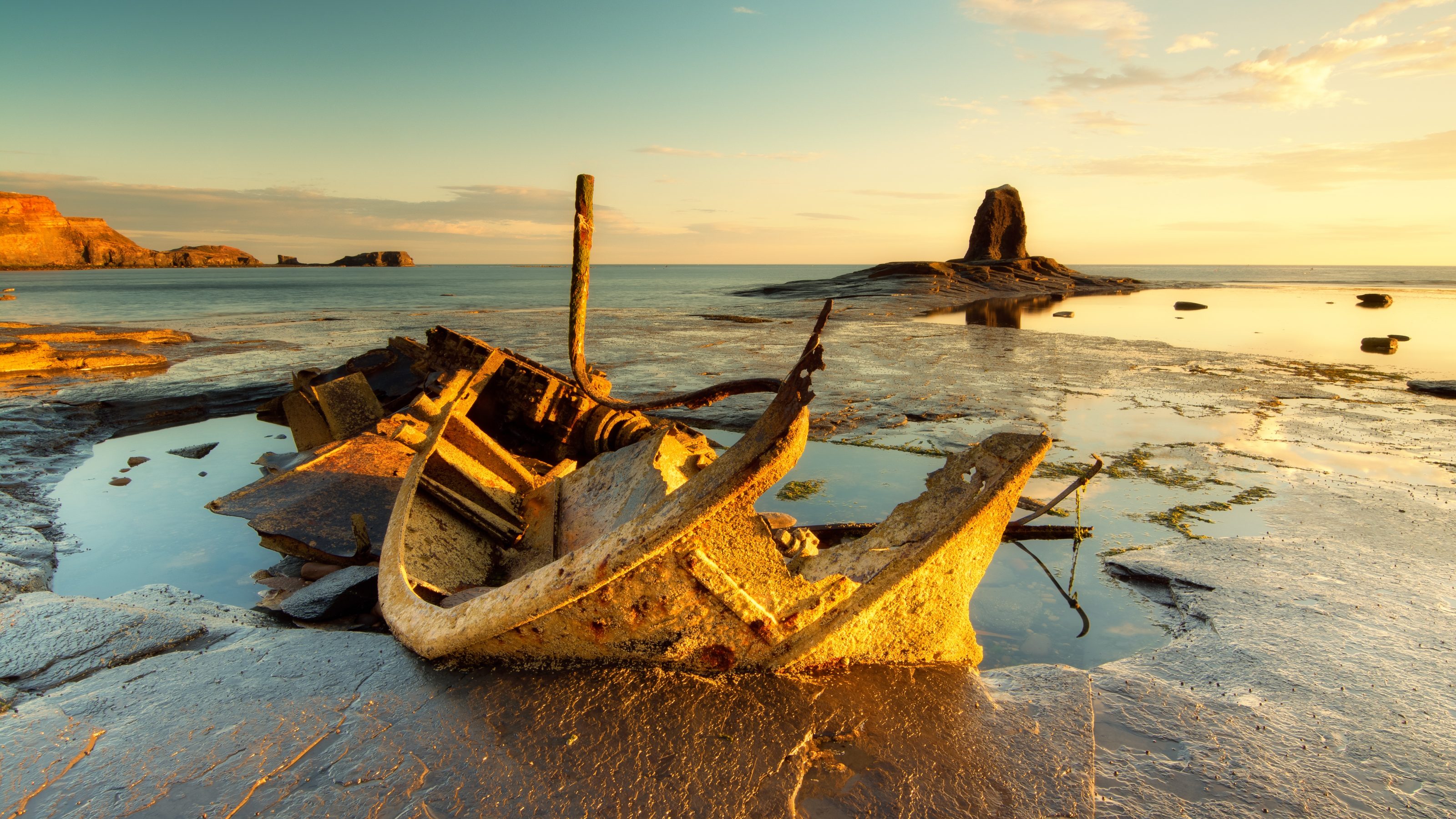
You’ll find the wreck of Admiral Von Tromp along the coast at Saltwick Bay, near the Black Nab. Tromp sank in 1976 although nobody is entirely sure what exactly happened. Whitby lifeboat attended the scene but struggled to get close to the crew safely. Sadly two members were swept away by the sea but after a struggle, the rest of the crew were rescued.

CRETEBLOCK

The coal barge and harbour tug Creteblock sank in 1947 while being towed away to be scrapped. It hit shallow water at Whitby Scar and went under at Saltwick Nab. The wreckage was blown up to avoid a hazard to other shipping so you will only be able to spot the concrete debris today.

SS ROSA

The remains of SS Rosa can be found at West Scar, North Landing near Flamborough. A lump of metal the size of a small car can be seen wedged in the rocks. This is the boiler from the once incredible Royal Navy fuel barge which went down in 1930. Amazingly, the 16-man crew were rescued by the Flamborough lifeboat.

SARB-J

Along the coast near Robin Hood’s Bay you’ll find Sarb-J. The fishing trawler originally sank in 1994 when its propeller got caught in rope and until recently, you could see the full shipwreck. The boat has since broken away but if you check the tide, you can still spot part of it perched on its keel under the cliff.


Have you stumbled upon any of these sunken secrets along the North Yorkshire coast when joining us for a stay on the edge of the North Yorkshire Moors?

Spectacular Lake District Walks on our Doorstep

With so many spectacular  Lake District walks on our doorstep, it’s a tough job narrowing the list down to just 5.

The Lake District National Park comprises 912 square miles of high mountains, lakes, rivers and coastline and receives almost 16 million visitors a year. No wonder, then, that it was loved so dearly by Beatrix potter, Alfred Wainwright, Arthur Ransome and William and Dorothy Wordsworth.

The landscape is steeped with footpaths and by simply stepping out of the front door when joining us for a stay in one of our Cumbrian cottages, you’re likely to find yourself walking an ancient trail with unerring scenery flanking your gait.

For those seeking a little guidance, here are some of the most spectacular Lake District walks on our doorstep, from gentle riverside rambles to stiff mountain ascents.

Take a Hike in Great Langdale

A hallowed name amongst fell walkers, Great Langdale is home to some of the Lake District’s most iconic hikes. Most people choose to tackle the Langdale Pikes, a spiky chain of hills on the valley’s northern side, but more experienced hikers might feel up to the challenging circuit along the Crinkle Crags and Bowfell. The official car-parks fill up early, although extra spaces are often available in nearby fields.

Explore Borrowdale, Buttermere & Honister Slate Mine

With its green fields, cob cottages, drystone walls and rolling fells, Borrowdale seems to sum up the spirit of the Lake District landscape. Neighbouring Buttermere feels altogether wilder and emptier; its twin lakes, Buttermere and Crummock Water, are overlooked by a string of dramatic fells. Separating the two valleys, the windswept Honister Pass is home to one of the Lake District’s last working slate mines, where you can take a 1.5-hour guided tour.

Say Hello to Helvellyn via Striding Edge

Helvellyn (3,117ft) is famous (or infamous) for its twin ridges, Striding Edge and Swirral Edge, carved out by glacial action during the last ice age. There are some considerable drops and steep sections involved, and at one or two points you’ll be climbing hand over hand, so it’s not for vertigo-sufferers. Don’t be deterred by the challenge, though – thousands of people manage Helvellyn every year. The most popular routes start in Glenridding or Patterdale.

Climb Scafell Pike

A journey to its summit and back will likely leave you with blisters and wind or rain-blasted skin. But you’ll also get a stunning view of the National Park and an enormous sense of smugness. Just make sure you prepare properly. That means checking the mountain forecast and getting the right gear (primarily, decent footwear). Sure it’s fun, but it’s also a pretty chunky undertaking.

Escape the crowds in Newlands Valley

There’s precious little to see in Newlands valley other than miles of empty fells and open countryside, but that’s the attraction. The Newlands Round makes a classic 10-mile loop around the valley’s main summits, and it stays fairly quiet even in the height of summer. The shortest route begins in the tiny village of Little Town, but it’s easier to park in Keswick and walk southwest through Brandelhow Park.

Browse our collection of Lakeland cottages each with spectacular Lake District walks on the doorstep.